Remarkably Bright Creatures: What an Octopus Teaches Us About Processing Grief
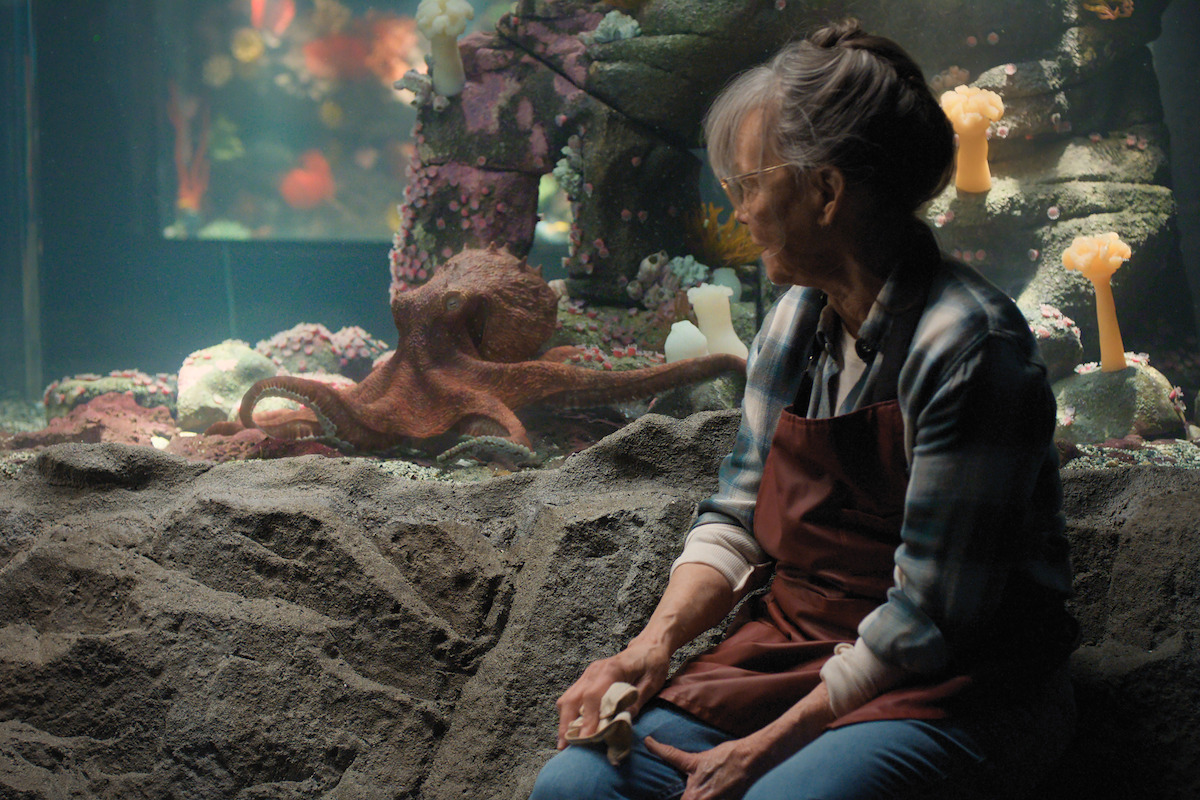
In the newly released Remarkably Bright Creatures movie, audiences are introduced to a story that is as eccentric as it is deeply healing. While most viewers are drawn in by the sharp wit of Marcellus, a Giant Pacific Octopus, at Mentespace, we are looking at the deeper current beneath the water: the complex journey of processing grief.
The narrative follows Tova, a woman living in the quiet wake of multiple losses, who finds an unlikely partner in an aquarium inhabitant. This story isn't just a charming tale; it is a clinical illustration of how interspecies connection psychology can act as a profound bridge for those struggling with social isolation and mental health.
1. Beyond the Five Stages of Grief: Tova’s Journey
For decades, the five stages of grief (denial, anger, bargaining, depression, and acceptance) have been the standard framework for understanding loss. However, in the Remarkably Bright Creatures movie, we see that Tova doesn't move through these stages in a straight line. Her grief is circular, often manifesting as a rigid need for order and cleanliness.
In psychology, this is known as "Instrumental Grieving." Tova uses her physical routine at the aquarium to manage her internal chaos. It is only when she meets Marcellus that she begins to move toward "Intuitive Grieving," where she allows herself to feel the weight of her past. This transition proves that how to heal from loss isn't about following a checklist; it's about finding a safe space to let the emotions breathe.
2. Marcellus the Octopus Psychology: The Power of Observation
The character of Marcellus the octopus psychology is fascinating because he represents a non- judgmental observer. An octopus perceives the world through thousands of neurons in its arms, creating a sensory-rich experience. For a human experiencing social isolation, the presence of such a sentient, yet silent, creature provides a unique form of "Social Co-Regulation."
Marcellus doesn't need Tova to explain her pain. He simply observes it. This mirrors the animal- assisted therapy benefits found in clinical settings. Interacting with highly intelligent animals can lower high cortisol levels and trigger a vagus nerve reset. By focusing on Marcellus’s needs, Tova effectively distracts her brain from its "Grief Loop," allowing her nervous system to return to a state of Ventral Vagal safety.
3. The "Blue Space" Effect: Why Aquatic Environments Calm the Vagus Nerve
The setting of the aquarium in the Remarkably Bright CreaturesRemarkably Bright Creatures movie isn't just aesthetic; it’s a therapeutic choice. In 2026, environmental psychology is heavily focused on "Blue Spaces", the mental health benefits of being near water. Much like the Shinrin-yoku we explored, aquatic environments trigger an immediate vagus nerve reset. The rhythmic movement of water and the muted, blue-toned lighting of the aquarium work to lower the cortisol levels almost instantly.
For Tova, the aquarium provides a predictable, sensory-rich environment that counters the loudness of her grief. Research published in the National Library of Medicine suggests that spending time in blue spaces significantly reduces the risk of psychological distress and improves overall social isolation and mental health outcomes. By simply being in the presence of Marcellus’s water-bound world, Tova is performing a biological "manual override" on her stress response, allowing her brain the safety it needs to begin processing grief.
4. Breaking the Cycle of Social Isolation and Mental Health
Social isolation is often the shadow of grief. After a loss, many people withdraw, believing that no one can understand their specific pain. In the film, Tova’s isolation is a choice she makes to protect herself from further hurt. This is a common coping mechanism, but it often leads to a decline in social isolation and mental health stability.
Remarkably Bright Creatures shows us that the antidote to isolation is often found in interspecies connection psychology. Animals provide a "Social Bridge." For Tova, her bond with Marcellus eventually forces her back into the human world, proving that connection with nature is often the first step toward reconnecting with people.
5. Cephalopod Cognition: Why Marcellus is the Perfect Grief Partner
When discussing Marcellus the octopus psychology, we have to address the sheer alien intelligence of the Giant Pacific Octopus. Octopuses possess a decentralized nervous system, meaning they "think" with their entire bodies. This makes them exceptionally sensitive to the emotions and physical presence of others. In the Remarkably Bright Creatures movie, Marcellus doesn't just see Tova; he senses her.
This is a vital component of interspecies connection psychology. Because an octopus is so vastly different from a human, there is no "social pressure" to perform or pretend. For someone learning how to heal from loss, the non-verbal, non-judgmental presence of a cephalopod offers a unique form of "Silent Co-Regulation." According to Scientific American, the complex cognitive abilities of octopuses allow them to form bonds that challenge our traditional understanding of animal-assisted therapy benefits, proving that deep emotional healing can come from the most unexpected corners of the animal kingdom.
6. The "Ink" of Memory: Why We Struggle to Walk Away
In the Remarkably Bright Creatures movie, the concept of memory is central. Marcellus remembers everything, while Tova is haunted by what she cannot forget. This highlights the Zeigarnik Effect we discussed before, the mind’s tendency to stay locked on unfinished business.
To practice how to heal from loss, one must learn to "release the ink." Just as an octopus uses ink to escape a predator, we must learn to express our grief to escape the "predatory" thoughts of the past. Whether through journaling, animal-assisted therapy benefits, or social support, finding a way to externalize the memory is vital for long-term emotional regulation.
7. Reframing the Five Stages of Grief: The Circular Path to Healing
The most significant takeaway from the Remarkably Bright Creatures movie is the realization that the five stages of grief are rarely a linear ladder. Tova often finds herself circling back to "Denial" through her cleaning or "Bargaining" with her memories. This is the reality of processing grief in the modern world; it is a messy, circular journey rather than a destination.
By the end of the film, Tova realizes that to heal from loss isn't about leaving the person behind, but about integrating their memory into her new reality. This aligns with the "Dual Process Model" of grief, where we oscillate between "Loss-Orientation" (feeling the pain) and "Restoration-Orientation" (building a new life). Through her bond with Marcellus, Tova learns to balance these two states, proving that even in the depths of social isolation, a remarkably bright connection can lead us back to the light.
Conclusion: Finding Your Marcellus in the Dark
Ultimately, Remarkably Bright Creatures reminds us that grief is not a cage, but an ocean. While we might feel lost in the "Blue Space" of our own sadness, the interspecies connection psychology displayed between Tova and Marcellus proves that we are never truly alone if we remain open to the world around us.
Whether you are navigating the heavy weight of social isolation and mental health or trying to find your way through the five stages of grief, look for your own "Marcellus." It might not be a Giant Pacific Octopus; it might be a mindfulness practice, a walk in nature, or the non- judgmental support of animal-assisted therapy benefits.
Healing doesn't happen when the grief disappears; it happens when we expand our world enough to hold both the loss and the life that follows. As Tova discovered, the most "remarkably bright" moments of healing often happen when we stop trying to scrub away the past and start reaching out, tentacles and all, toward a new connection.